Timing Risk in a Reserve Fund
Why a reasonable reserve management decision can create a cash problem, and when a board can still see it coming.
Reserve funds commonly use instruments such as certificates of deposit to earn higher returns on their holdings. Reserve studies typically assume some level of interest income, and that income is real revenue - it reduces what owners have to contribute. So investing for higher returns may sound like a no-brainer. But what risk does that entail?
A higher return often comes with a condition: the association may have to commit its funds for a specific period. The higher rate is tempting. If the association can earn more by committing the cash for a longer term, the choice may seem straightforward - let the money work harder.
That may sound like simple arithmetic. It is not.
The investment term cannot be evaluated in isolation. Behind that decision is a reserve plan with projects scheduled across many years, contributions based on assumptions that may change, and multiple future obligations competing for the same cash. When the maturity and project schedules conflict or change unexpectedly, it may create a timing risk - the unavailability of funds when they are needed.
A decision that appears reasonable when viewed only through the bank statement may create timing risk when viewed against the reserve calendar.
A reasonable decision with unseen risk
The charts below follow a hypothetical reserve cash position through a period of ordinary decisions. The red bars are scheduled reserve expenditures. The brown line is the total value of the fund. The green line is cash actually available to spend. The difference between the two lines is cash committed to term investments.
Only the green line determines whether a project can be paid for. If it falls below zero, the association cannot fund a scheduled expenditure when it comes due.
September 2026
A certificate of deposit matures, and roughly $60,000 becomes available. The association runs a twelve-month ladder and has always reinvested at maturity. Available cash looks healthy. The board faces a routine decision: leave the money liquid, or extend it for another term at a better rate.
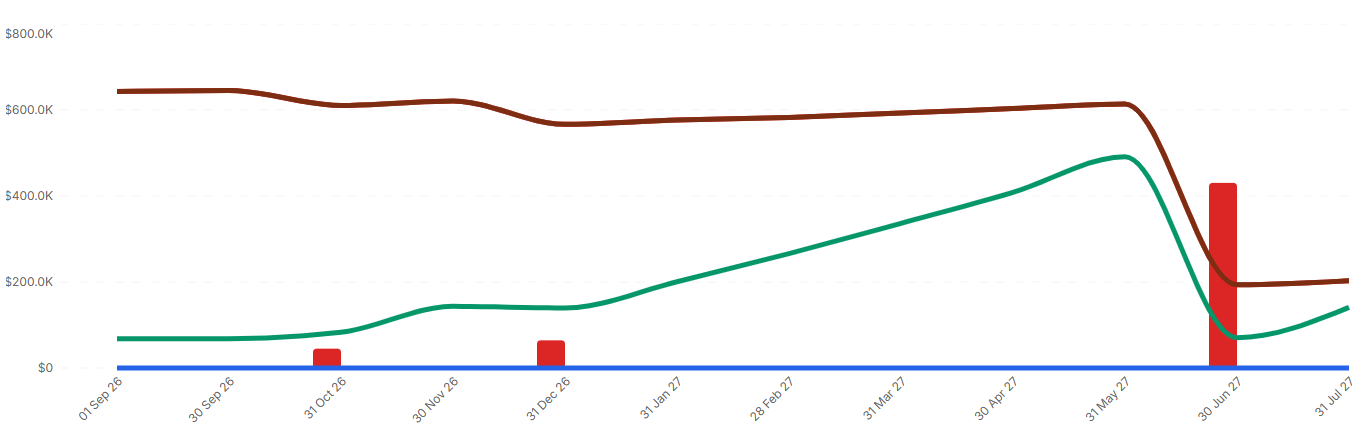
Extending looks sound. Reinvested, the projection still works. Nothing in the twelve-month view says otherwise.
The same month, extended
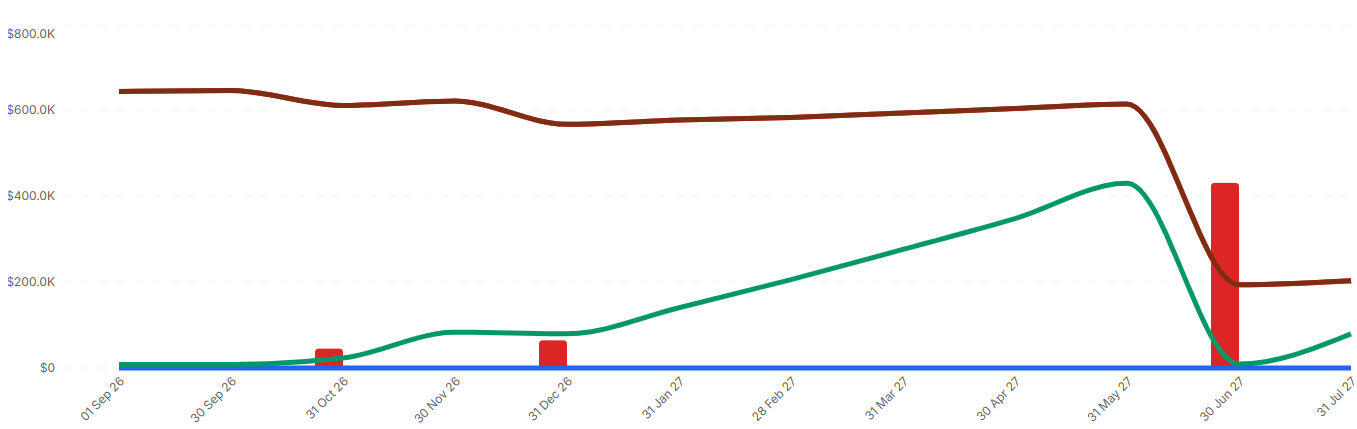
But look at the green line through late winter. It comes close to the floor. The plan holds, but there is very little room between available cash and the expenditures scheduled against it. Most of the association’s margin has been traded away for the additional return.
That thin margin is the exposure. It only matters if something moves.
Something moves
In the following illustration, schedules shift. Projects advance by three months. A contractor’s availability changes, a permit clears early, a component fails ahead of schedule. Nothing dramatic; a three-month shift is unremarkable in reserve work.
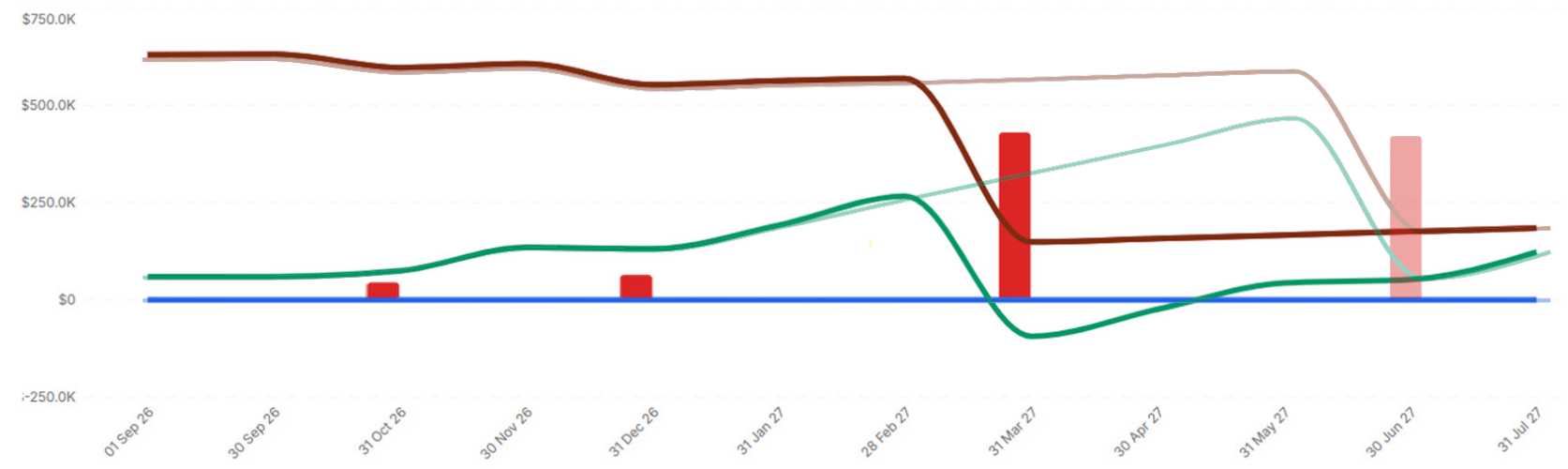
The green line goes below zero. The association now faces a cash shortfall, not because it lacked funds, but because the funds are committed and the projects arrived early. And because the cash was reinvested in September, there is very little the board can do about it now. What remains are the expensive options: early withdrawal penalties, financing costs, delayed work, or a special assessment.
Here is the part worth sitting with. The September decision was not careless. It was made with real information, on a reasonable view of the year ahead, by a board doing what it had always done. The board had the project plan that gave a date and cost, and a bank statement that provided a cash balance.
What neither document shows is the relationship between them, where the dates on one fall against the balances on the other. And neither document shows where those two things fall out of alignment. That is the part no one was looking at, because nothing puts it in front of them.
Rewind to January 2026
Apply exactly the same three-month timing shift to the position the association held at the start of the year.
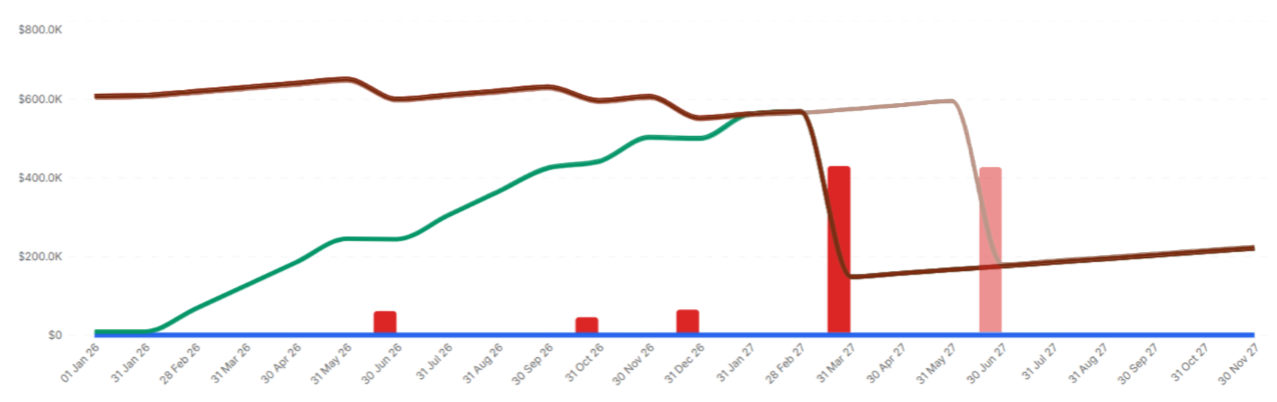
The shortfall does not appear. The structure absorbed it. There was enough available cash to fund the accelerated projects without penalty or financing.
But notice what else the chart shows: a considerable amount of cash sitting uninvested for most of the year. The January position was liquid enough to survive the shift, and it earned less than it could have been. That is a real cost as well, and it is the cost boards accept when they hold everything liquid out of caution.
So the association was protected in January and exposed in September. The risk was not created by the September decision. It accumulated quietly in between, and by September, the ability to manage it was already gone.
The useful question is when that window closed.
May 2026
The association is at another decision point, and it still has flexibility.
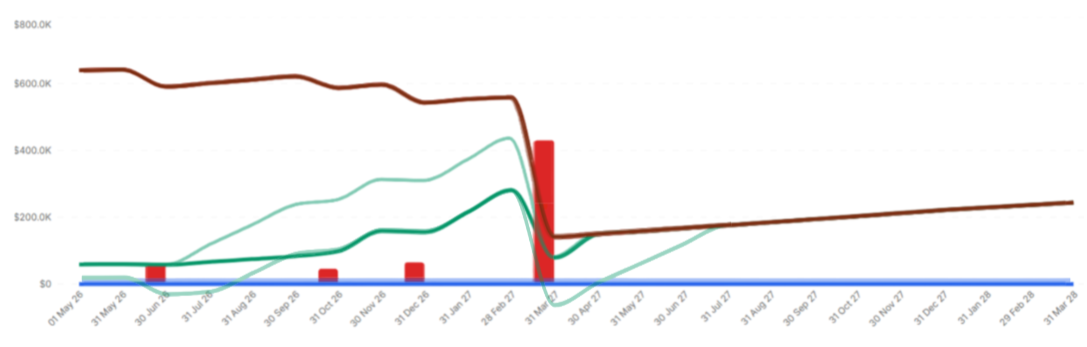
From here, there are three commonly used, yet broadly different ways to position the same funds:
- Hold everything liquid. Removes the risk of maturity mismatches, and it gives up the return available on committed funds.
- Ladder maturities as before. Earns more, and it reintroduces the shortfall risk shown above.
- Match maturities to the reserve calendar. Longer terms and better rates, but it gives up flexibility if project dates move.
None of these is automatically correct. That is the point. Each is a defensible reading of risk and return, and choosing among them is an exercise for the board and its financial advisor. Many reserve management plans use a combination of these three positions.
September 2026, again
This is the same month as the first chart, reached by a decision made in May, when options were still available to the board.
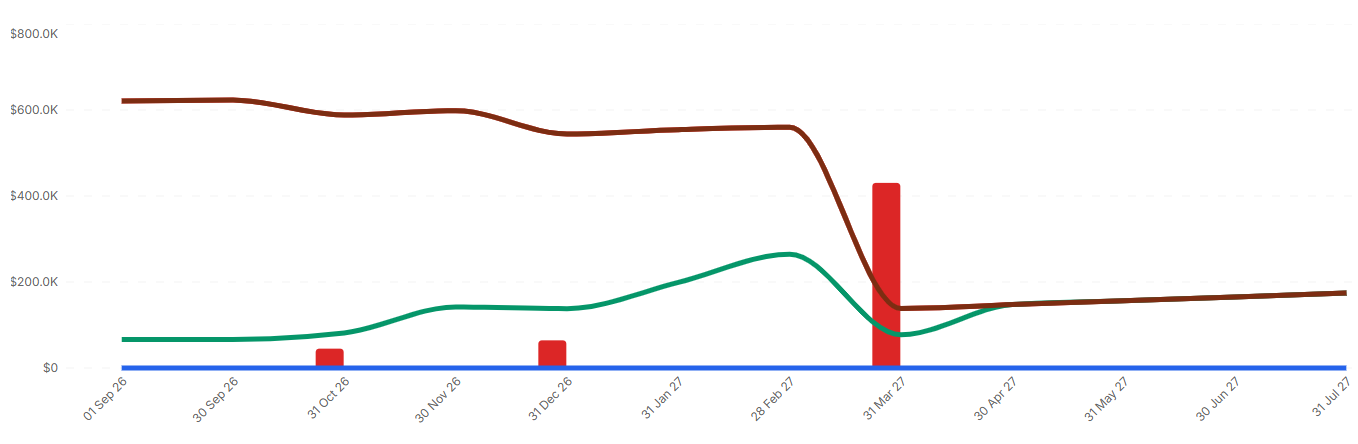
Available cash is stronger, and the association is not holding everything in cash to get there. Both improved. Cash is available when projects need it, and the fund is still earning on the funds that remain committed. That comes from reading the two schedules together, investments and projects, and asking what happens when they don't align — while there is still time to do something about it.
Jennifer Helle is a co-founder of Telemetryx Reserve Analytics, which gives community associations and their management companies a connected view of reserve funding, liquidity, and risk. She spent her career in institutional financial risk management before serving on a condominium board.
See Telemetryx for yourself.
Ready to see what clear reserve planning looks like for your community?
Request a DemoThis article is published for educational and informational purposes only. It does not constitute legal, financial, investment, accounting, or engineering advice. Community associations operating in Florida are subject to strict statutory requirements under Chapters 718 and 720 of the Florida Statutes, including mandated Structural Integrity Reserve Studies (SIRS). Readers must consult with licensed Florida attorneys, Certified Public Accountants (CPAs), financial advisors, and qualified structural engineers before adopting financial strategies, setting reserve budgets, or altering investment allocations. The information herein is general in nature and may not apply to your specific community association’s governing documents or financial position. Nothing in this article is a recommendation to buy, hold, or sell any security or investment product, or to use any particular financial institution.

Reserve planning and risk analytics. Visibility and financial clarity for every community.
support@telemetryx.app